One artwork is often a great storyteller.
Before resuming my findings at Portobello Road Market I should go back in time to the artwork that actually started this collection, although at that time there was no evidence that this painting on board would ever be hung together with other artworks.

I bought this picture at Royal Trinity Hospice, Shepherds Bush (Hammersmith), in July 2019. The technique used seems to be egg tempera or gouache on paper laid on board. The measures are 25 x 31 cm. The painting is neither signed nor dated.

If I had to date the artwork, I would say it is late 19th or early 20th century. This style of composition fits in well with that period. An example is the engraving Shepherd Girl reproduced in Samuel Gosnell Green's French Pictures drawn with pen and pencil. With illustrations by English and Foreign artists (p. 157), which dates from 1878.

Shepherd Girl (1878). The British Library.
Later in date, and in a fluid, non-academic style, is Breton Girls on a Beach, by Irish painter Aloysius O'Kelly (1853-1936), probably painted in the first decade of the 20th century. O'Kelly discovered Brittany in the summer of 1876, while studying in Paris.

Such compositions were painted directly en plein air, and were inspired by the naturalism of Jules Bastien-Lepage and his followers.

But, what does our picture really portray? The sitters are two girls from a coastal village dressed as peasants or shepherds on a rock watching the sea. One of them is wearing traditional Breton costume. Although the exact location of the present artwork is unknown, the composition seems to capture the vibrant Breton coast in northwest France. The scene may well be located in Concarneau, Brittany. There, as on the Breton coastline in general, it is easy to find this type of rocky coastal landscape, like the one in the setting of this painting.
The picture captures an intimate moment between two Breton girls, perhaps on the way to or from market day. Both figures are shown resting on a large rock after fishing. One of them appears standing carrying a basket of fish and holding the stick of a fishing net. The other one is seated and holding a shrimp or prawn in her hand. The outfit of this latter girl reminds us of the regional Breton costumes we can see during ‘Le Festival des Filets Bleus’ (Festival of Blue Nets).
We know that a painting directly connected to this artwork was auctioned at Christie's South Kensington the 11th May 2000 (Catalogue "Maritime", lot 494). The details of that auctioned painting state the following: "Waiting for Father's Return by J. Coghlan. 19th century painting".

We also note that the same artwork was auctioned on other occasions and in different auction houses: Canterbury Auction Galleries, UK: J. Coghan: “Waiting for Father's Return" or "Shrimp Girl with Net". Oil painting (19th Century School). Canvas 36ins x 28ins. Signed and indistinctly dated 18.. Provenance: Christie’s. February 7, 2017, Lot 279; April 4, 2017, Lot 278. Est: £800 - £1,200.
Who was artist J. Coglan?
Christie’s catalogue "Maritime" (lot 494) states that Coglan was a 19th century artist. We would infer that it is a picturesque composition by a Victorian painter. Actually, there is not much information about painter J. Coghlan, but she might well be an amateur British painter called Florence Jane Cogger (1878-1939).This artist was born in Norbiton, Surrey. She was the daughter of Suzannah and Thomas Cogger. She moved to Kingston on Thames, Surrey, living at 29 Barnfield Avenue. After her mother’s death in 1930 she moved to the family house, living at 10 Arthur Road, Norbiton. Her father had died in 1906. As an artist she mainly painted flowers and figure scenes in watercolour and oil on canvas. Like many other Victorian or Edwardian painters, it is thought that she could have had some kind of contract with a gallery to paint her artworks, but she probably found that she could make some extra money by painting for other galleries under an alias, and some of her paintings are signed as J. Coghlan. As the Civil Registration Death Index 1916-2007 of England & Wales states, Florence J. Cogger died in Surrey in 1939.
According to the Royal Academy catalogues, she exhibited some of her artistic works at Burlington House's South Rooms at least in 1928, 1932 and 1935. Those paintings are all signed as Florence J. Cogger: Flowers (RA 1928); Delphiniums (RA 1932); Sweet Peas (RA 1932); White Roses (RA 1935). She also exhibited at the Abbey Gallery, Royal Society of Arts Birmingham, Walker Art Gallery Liverpool, Manchester City Art Gallery, Royal Society of Portrait Painters, Royal Society of British Artists, Royal Hibernian Academy Dublin, Royal Institute of Painters in Watercolour, Royal Scottish Academy, and at the Society of Women Artist. Signed as J. Coghlan we can find Waiting for Father’s Return -also Shrimp Girl with Net-, The Flower Gatherers, and The Winning Post.
I have to admit that researching Florence J. Cogger stimulated in me a great interest in how an artist can access the most important artistic events in London, and after some time I discovered that if you are a talented artist, both British or international, you can exhibit your artwork at the Royal Academy Summer Exhibition or in the multiple exhibitions held in the Mall Galleries by the different British artists' societies: Royal Society of Portrait Painters, Royal Society of Marine Artist, Royal Institute of Oil Painters, The Pastel Society, Royal Society of British Artists and Royal Institute of Painters in Water Colours, to name a few of the best known. Unsuccessfully, I myself attempted to submit some entries to some of these exhibitions, including the 2020 Summer Exhibition. I was not lucky enough, but it was an amazing experience, but I must admit that at one of the events hosted at Burlington House I had the privilege of meeting the 27th president of the Royal Academy of Arts, Ms. Rebecca Salter PRA.
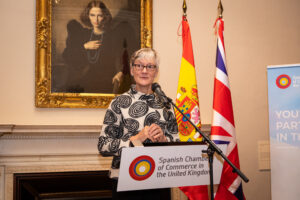
Photo: Spanish Chamber of Commerce in the UK (February 2020).
Moving back to the pictures, obviously both paintings have a close relationship, but also notable differences. The first one shows a pictorial quality that is absent in the auctioned painting. Compared to our first artwork, Coglan’s presents some additions such as a dog along with the girls and a boat in the background. The faces of the girls depicted lack the mastery of the first picture, show little expression, and the elaboration of the work is too over-painted, lacking in technical or artistic quality, typical of an amateur painter. Our image, however, has a freshness and a technique characteristic of a skilled hand. The artist has used the glazing technique, with stylistic features recalling some academic paintings by Bouguereau and Émile Munier.

There is no doubt that both painting are artworks by different hands. One hypothesis is that the author of “Waiting for Father's Return” would have used this painting as a sketch, and tried to depict the same scene by adding details about the taste of potential Victorian or Edwardian customers, if the date in Christie's catalogue is not accurate. The other possible explanation is that both pictures shared the same source.
To enhance the mystery of this artwork, a reverse image search revealed a third painting almost identical to the charity's, this time in a French antique market. Even without having closely examined this picture, it could be said that both artworks are by the same artist's hand, although this latter one is considerably damaged as a result of its age.

And days later I found a fourth picture, auctioned in Sweden, this one of a poor technical quality, but that undoubtedly shares the same source of inspiration.

This leads us to a third hypothesis. We have four connected paintings but in different geographical locations. We know that some academically trained artists offered lessons by post to amateur artists such as Florence J. Cogger. They often advertised themselves in the newspapers and artists' magazines, and probably mailed paintings on paper for their pupils to copy.
And then a fifth hypothesis emerges, which is directly related to the costumes worn by the sitters. Perhaps it was not the paintings that travelled, but the artists themselves in search of inspiration.
Concarneau Art Colony.
This last hypothesis would tell us about an artwork by some local artist that would be sold as a souvenir to visiting artists or wealthy tourists, perhaps acquired in one of the artists' colonies that flourished in Brittany since the 19th century. In fact, it was one of the French regions most frequently visited by artists, many of them settled in artists' colonies in Concarneau, Pont-Aven, Cancale and several other villages in the region. Many other artists visited these colonies in summer, looking for inspiration. The endless diversity of coastal and inland landscapes, as well as the Breton inhabitants with their customs, costumes, beliefs and legends definitely fascinated them.

Between 1830 and 1914 it is estimated that there existed over 80 rural artists' colonies, most of them in France, Netherlands and Central Germany, with artists from at least 35 different countries, being the Americans, British and Germans the largest body. Concarneau's is of special interest to us because it influenced British artists who later founded new colonies in the UK, Newlyn and St Ives for instance, and because there we find artists who depicted scenes that explain the practice of fishing with net that we observe in our painting. Of those artists and some of their artworks relevant to our painting we will talk about in the following post.


Comentarios
Publicar un comentario